

-
About UsZHONGTAI HENGBANG Engineering Technology Co., Ltd. is located in the Academician Entrepreneurship Base of Tai'an National High-Tech Industrial Development Zone, Shandong Province. The company is a comprehensive service provider specializing in engineering consulting and design, materials R&D and manufacturing, as well as operations and maintenance. With strong technical expertise and robust R&D capabilities, its products are primarily applied in critical areas such as water conservancy infrastructure projects, transportation infrastructure initiatives, and environmental protection solutions for isolating and preventing leakage from urban waste and highly hazardous industrial solid waste.

-
ProductsZHONGTAI HENGBANG Engineering Technology Co., Ltd. boasts production lines sourced from countries including Germany, Italy, Denmark, Belgium, and Switzerland, adhering to rigorous quality management systems and testing standards. We are equipped with advanced testing equipment capable of evaluating tensile strength, creep resistance, UV protection, water permeability, flame retardancy, antistatic properties, chemical corrosion resistance, and oxidation performance.
-
Application CasesThe product is primarily used in hydraulic infrastructure projects, transportation infrastructure projects, and environmental protection applications—including the isolation and impermeability of municipal waste and highly hazardous industrial solid waste.
-
BlogPrioritizing technological advancement and innovation, our company is committed to fulfilling user needs to the fullest extent possible.
Technical Standard for Geosynthetic Materials in Railway Engineering – Geomembranes (Q/CR 549.3-2016)
Release date:
2020-07-20
With the rapid economic development, the types, varieties, and quantities of geosynthetic materials in China have steadily increased, while their applications—and the sectors in which they are used—are becoming increasingly diverse and widespread.
I. Introduction
With the rapid development of the economy, China has seen a gradual increase in the types, varieties, and quantities of geosynthetic material products, while their applications—and the industries they serve—have expanded significantly. To promote standardization and regularization of geosynthetic materials, align product-related technical requirements, and ensure high-quality products and projects, relevant Chinese industries have recently drafted or revised standards and technical specifications for geosynthetic materials and their applications. To help industry peers stay informed about these key standards (and regulations) and keep up with the latest developments, the Secretariat of the China Geosynthetics Engineering Association has been systematically collecting, organizing, and interpreting the most pertinent geosynthetic-related standards and guidelines.
This issue introduces the China Railway Corporation standard—*Geosynthetics for Railway Engineering, Part 3: Geomembranes* (Q/CR 549.3-2016), which was officially issued and came into effect on January 8, 2017.
II. Necessity of Preparation
Geomembranes have been widely adopted in railway engineering, serving applications such as reinforcing the subgrade and ballast beds in new railway construction, addressing issues like heaving, mud pumping, and ballast pockets in existing railway subgrades, preventing surface water infiltration in areas with expansive soils, loess, and other challenging geotechnical conditions, and isolating subsurface capillary water in saline and permafrost regions. In tunnel waterproofing and drainage projects, geomembranes are typically laid behind tunnel linings to ensure effective waterproofing. Additionally, in slab-type ballast-free track systems, composite geomembranes are installed beneath the base plates to enhance anti-slip performance.
Although geosynthetics membranes are widely used across various fields and come in numerous application types, each with its own unique technical requirements, the railway industry has historically lacked a corresponding product standard. As a result, when designing and constructing railway projects, engineers have primarily relied on national or industry-specific standards to establish design, construction, and inspection criteria. This has led to inconsistent product standards for geosynthetics membranes within the railway sector, as well as non-uniform testing methods and procedures. Consequently, human factors play a significant role, making it challenging to effectively control the quality of products at the project site.
To ensure construction quality, incorporate recent technological advancements, standardize the application of geomembranes in railway engineering design and construction, and reflect the unique characteristics of railway projects while harmonizing relevant technical requirements, China Railway Corporation has initiated the development of the product standard "Railway Engineering Geosynthetics — Part 3: Geomembranes."
III. Main Content of the Standard
(1) Developed methods for classifying geomembrane products, along with naming conventions, product specifications, and application guidelines.
(2) Technical requirements have been established for geotextile membranes and composite geotextile membrane products used in railway engineering, outlining clear specifications regarding raw materials, appearance quality, and technical performance.
(3) Proposed test methods for sampling and specimen preparation of geotextile membrane products, as well as for evaluating indicators such as appearance and dimensions. Additionally, standardized testing procedures were established for key properties of geotextile membranes, including tensile strength at break, yield strength, elongation at break, puncture resistance, carbon black content, carbon black dispersion, density, right-angle tear load, oxidation induction time, low-temperature impact brittleness, dimensional stability, and, for composite geotextile membranes, tensile strength at break and elongation, CBR puncture resistance, hydrostatic pressure resistance, basis weight, tear strength, dynamic perforation (drop cone test), coefficient of friction, in-plane water flow rate, creep behavior, antioxidant performance, acid-alkali resistance, puncture resistance, joint/seam tensile strength, UV resistance, permeability coefficient, abrasion resistance, peel strength, stress-strain characteristics under constant load, and stress-strain behavior under fixed elongation. Detailed specifications regarding the principles, equipment, specimen preparation, and test procedures for these primary tests are provided in the form of appendices.
(4) Inspection rules for geotextile membrane products have been established, covering aspects such as inspection classification, factory inspection, type testing, batch formation and sampling, and acceptance criteria.
(5) Specifies detailed requirements for the marking, packaging, transportation, and storage of geotextile membrane products.
IV. Brief Introduction to Selected Standards
Here’s a brief introduction to selected sections of the standard; for more detailed information, please refer to the product standard itself.
(1) Specifies the classification of geomembrane products used in railway engineering
(1) Geomembranes are primarily classified by their raw materials, with high-density polyethylene (HDPE) geomembranes being the most common type.
(2) Composite geomembranes can be classified, according to the type of base material, into non-woven fabric composite geomembranes, woven fabric composite geomembranes, and more.
(3) Composite geomembranes can be classified, according to their functional use, into waterproof barrier-type composite geomembranes, lateral drainage-type composite geomembranes, and reinforced-type composite geomembranes, among others.
(4) Composite geomembranes can be classified according to their product structure into types such as one-layer fabric-one-layer membrane and two-layer fabric-one-layer membrane.
(II) The naming standards for geomembrane products used in railway engineering have been established.
The product naming format for geomembranes is shown in the figure below:
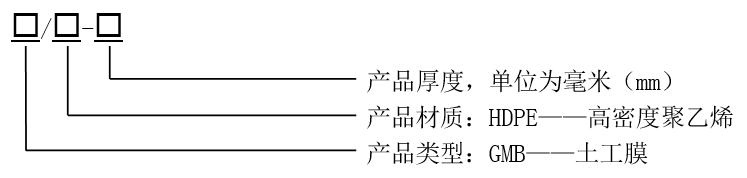
For example, GMB/HDPE-0.3 means: The geomembrane material is made of high-density polyethylene, and the membrane thickness is 0.3 mm.
The product naming format for composite geomembrane products is shown in the figure below:
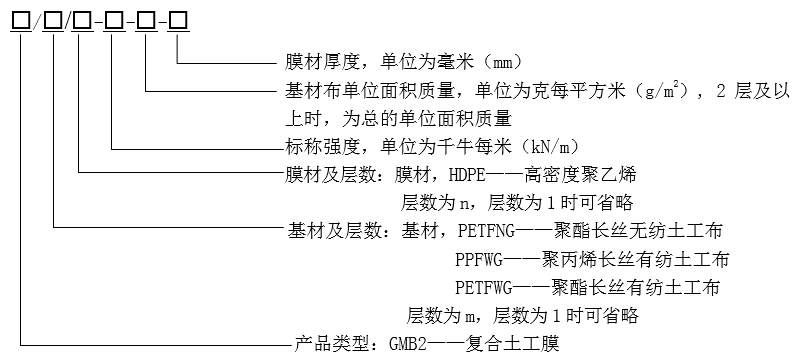
For example, GMB2/PETFNG2/HDPE-16-700-0.35 indicates: a composite geomembrane with a base layer of two layers of polyester long-fiber nonwoven geotextile and a membrane layer made of one layer of high-density polyethylene geomembrane—resulting in a "two geotextiles and one geomembrane" structure. It has a nominal tensile strength of 16 kN/m, a total basis weight of 700 g/m², and the membrane material is 0.35 mm thick.
(III) Defined the scope of application for geotextile membrane products used in railway engineering.
Geomembranes and composite geomembranes are widely used in railway engineering—primarily for subgrade reinforcement, treatment of subgrade defects, and preventing surface water infiltration or isolating underground capillary water in areas with challenging geotechnical conditions. In tunnel projects, they are mainly employed for post-lining waterproofing and drainage. In ballast-free track structures, they serve key functions such as waterproofing and drainage beneath the base slab, as well as anti-slip measures.
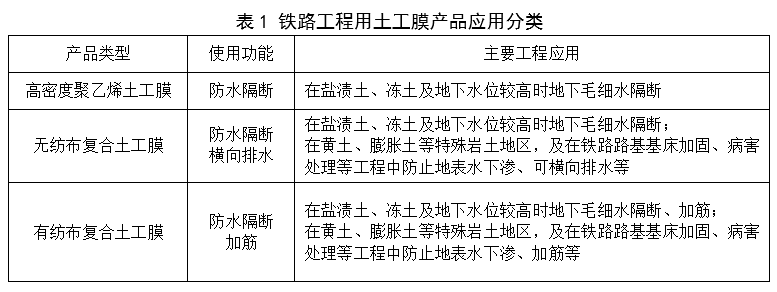
Due to the fact that the "Railway Tunnel Drainage Board" has already been developed for railway tunnel projects, the performance requirements and practical application effects of composite geomembranes under base plates in track engineering still need to be verified. Therefore, the development of this geomembrane standard is currently focused solely on geomembrane products intended for use in subgrade engineering. In railway subgrade projects, these membranes primarily serve functions such as waterproofing, lateral drainage, and reinforcement. The main application areas for geomembrane products are outlined in the table below:
(IV) Specifies the technical specifications for geomembrane products used in railway engineering.
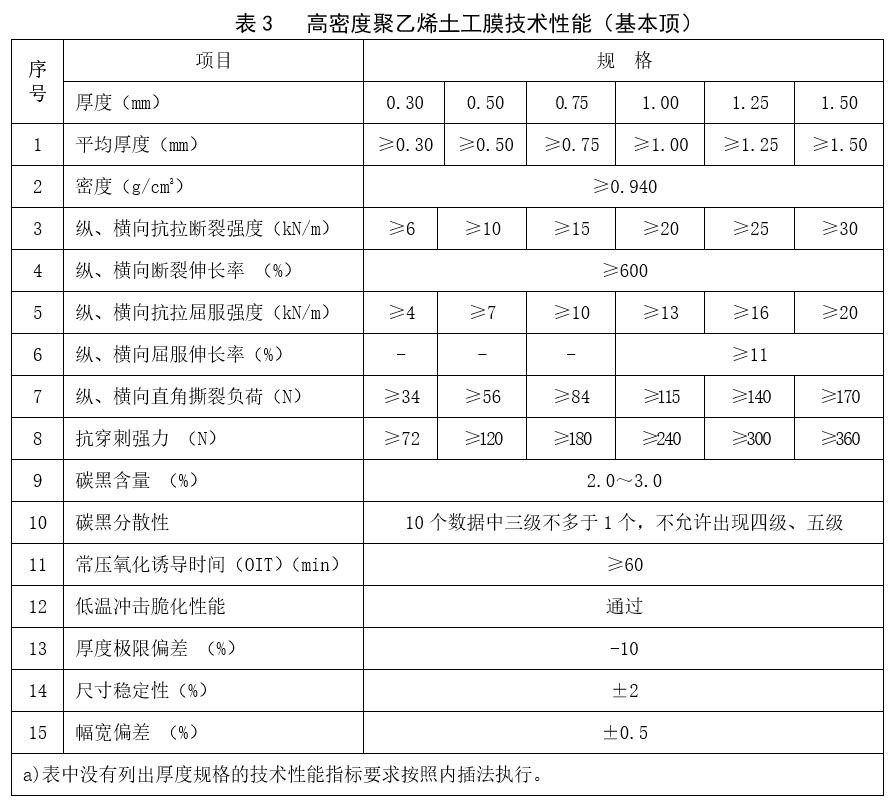
This standard categorizes technical specifications into mandatory items and optional items. Mandatory items are the criteria that products must meet, while optional items are requirements that need to be satisfied based on design or practical needs. For instance, taking high-density polyethylene geomembrane products as an example, the specific mandatory technical performance requirements are outlined in the table below:
Latest Updates
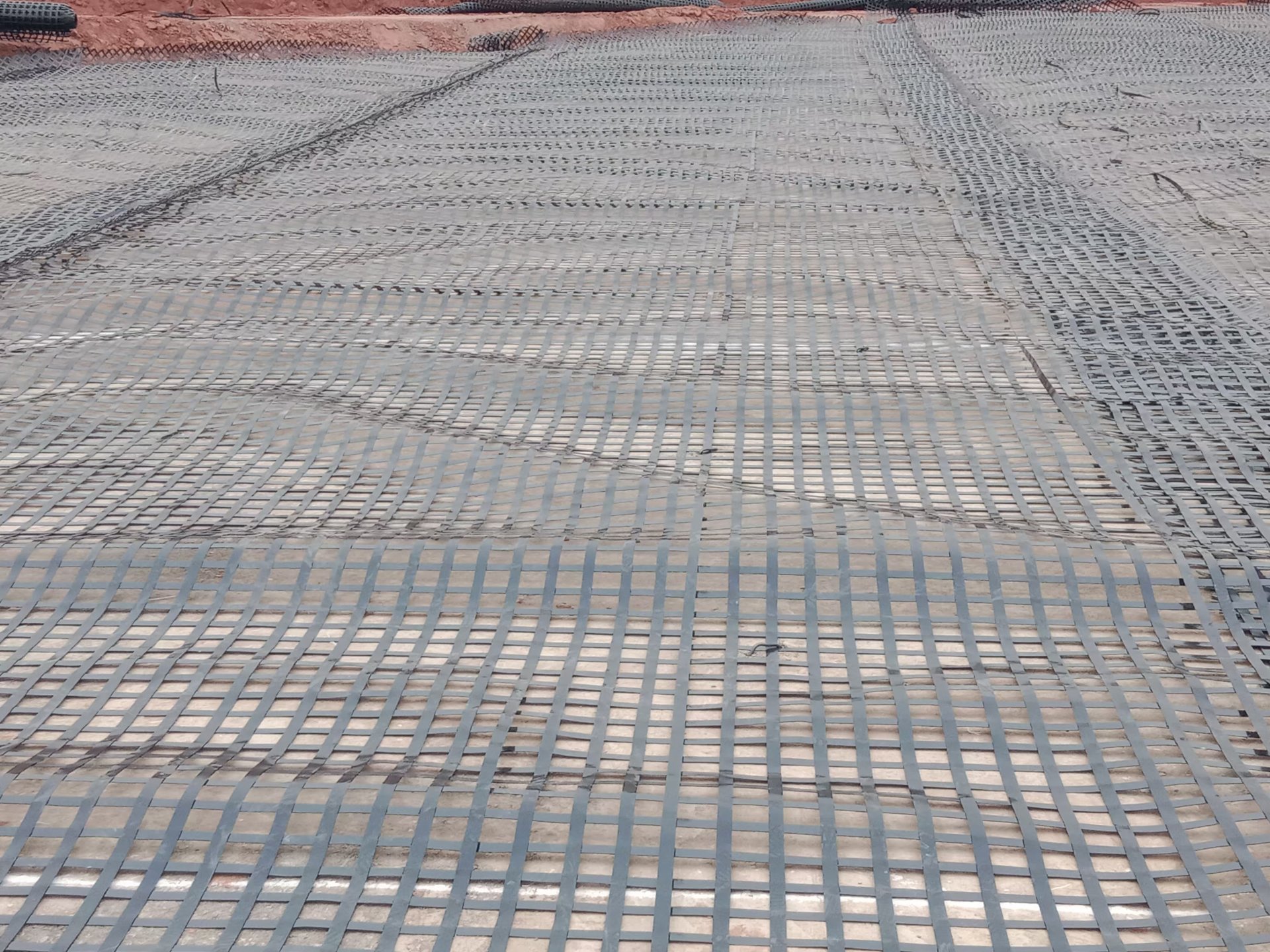
ZHONGTAI HENGBANGPET Polyester Welded Geogrid Advantages
Relying on independent innovation and technological expertise, Taihengbang Engineering Technology Co., Ltd. has achieved groundbreaking progress in the geosynthetics field. The company’s newly developed and produced PET polyester-welded geogrids, backed by multiple core patented technologies, have set a high-standard industry benchmark. Built on high-strength polyester materials and crafted through advanced precision welding techniques, these geogrids feature a robust, stable mesh structure, delivering exceptional performance in terms of tensile strength, durability, and environmental adaptability.
Jingzhe | Spring thunder rumbles, and all things grow.
Around March 5, the first spring thunder begins to rumble, rousing hibernating insects and snakes from their winter slumber. Peach blossoms start to peek out on the branches, and the earth softens as new buds emerge.
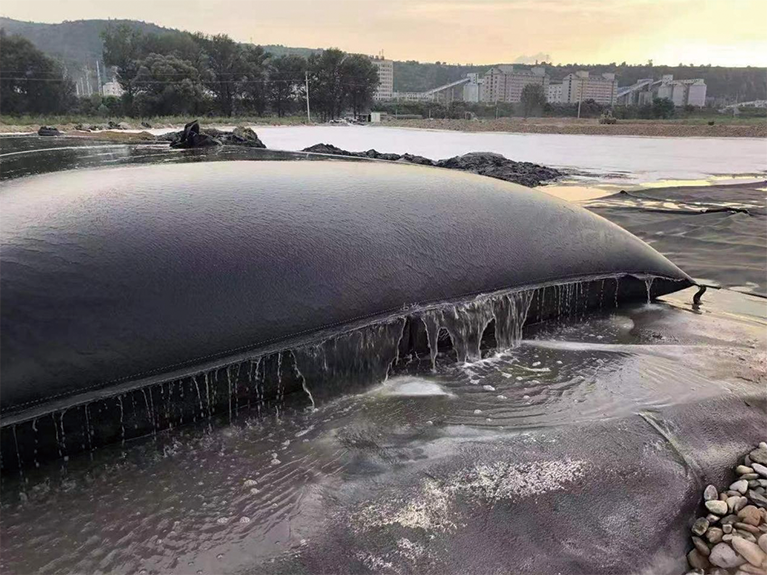
Geotube: A sludge dewatering tool—your eco-friendly engineering ally
A geotube is a tubular bag made by sewing together high-strength geotextile fabric. Utilizing the natural principle of gravity filtration, it removes water from sludge, effectively separating mud from water.
February 2, Dragon Raises Head: A Forgotten Spring Festival Celebration
On the second day of the second lunar month, spring returns to the earth, and all things awaken from their winter slumber. On this day—gradually fading from modern memory—lies one of the deepest cultural codes of the Chinese nation. The "Dragon Rises" is not just a seasonal marker; it’s also a spiritual totem for the Chinese people—a cherished legacy of our agricultural civilization.
Construction Plan for Laying and Welding of Composite Geomembranes
Construction Plan for Laying and Welding of Composite Geomembranes
Introduction to Drainage and Waterproofing Sheets
Introduction to Drainage and Waterproofing Sheets
ZHONGTAI HENGBANG Technology Co., Ltd.
Address: East Section of Zhongtianmen Avenue, Tai'an High-tech Zone, Shandong Province
Service Hotline